

Open your kitchen cupboard, and you’ll probably find a few empty plastic containers you’ve kept for later. At the same time, biscuit wrappers, takeaway boxes, and vegetable scraps keep piling up in your rubbish bin throughout the week.
It adds up quickly.
You might have seen those spotless zero waste kitchens online, with rows of matching glass jars and not a plastic packet in sight. They look lovely, but they don’t tell you much about living with less waste when you’re short on time or watching every rupee
You don’t need any of that stuff to begin.
An empty pickle jar can hold lentils. An old T-shirt can become a cleaning rag. The cloth bag buried at the bottom of your cupboard can save you from collecting another plastic shopping bag.
The trouble starts when people try to change everything at once. They replace perfectly usable containers, buy expensive alternatives, and then struggle to keep up with all the new rules.
A zero waste lifestyle works better when you start with the rubbish you produce most often and tackle it one habit at a time.
Some packaging will still come home with you. Your local shops might not offer unpackaged groceries, and the cheaper option sometimes comes wrapped in plastic. You can only work with what’s available.
This guide covers 10 practical steps to help you start a zero waste lifestyle, make your belongings last longer, and avoid spending money on things you don’t need.
What Is a Zero Waste Lifestyle?
A zero waste lifestyle means trying to prevent waste before it reaches your rubbish bin.
Rather than buying something, using it briefly, and throwing it away, you look for ways to keep it useful.
That could mean sewing a loose button back onto a shirt, carrying a refillable water bottle, or cooking the vegetables you already have instead of buying more.
The name can be misleading, though. Zero waste doesn’t mean you’ll never throw anything away.
Walk through an ordinary grocery shop, and you’ll see why. Biscuits come in plastic packets. Medicines come in blister packs. Even basic household supplies often have layers of packaging.
You can’t control all of that.
A realistic zero waste lifestyle takes these limits into account. Your choices matter, but manufacturers decide how they package products, shops decide what they stock, and local authorities influence what happens to waste after collection.
The aim is to throw away less without making everyday life unnecessarily difficult.
Why Should You Start a Zero Waste Lifestyle?
The rubbish truck might clear your bin, but the waste still has to go somewhere.
Some of it ends up in landfills or dumping grounds. Other materials go to recycling centres or incinerators, depending on the waste services in your area.
Starting a zero waste lifestyle can help you reduce unnecessary waste and make better use of the things you already own. When you use products longer and avoid unnecessary purchases, you reduce the need for replacement materials and the waste that comes with them.
There’s also a more immediate reason to pay attention: your household budget.
Think about the spinach you bought on Monday and found slimy in the fridge on Friday. Or the bottled water you keep buying because you forgot your own bottle.
A shirt with a missing button doesn’t always need replacing. Sometimes, a needle, some thread, and five minutes are enough to get more use out of it. Small repairs like this can save you money over time.
But not every zero waste lifestyle alternative is cheaper. Reusable products can be expensive, especially when you’re paying more upfront. Refill shops aren’t available in every neighbourhood, either. And when you’re already managing work, cooking, and household chores, finding extra time to make these changes isn’t always easy.
Still, many of the most useful zero waste lifestyle habits involve buying less, not buying something different.
How to Transition to a Zero Waste Lifestyle Step by Step
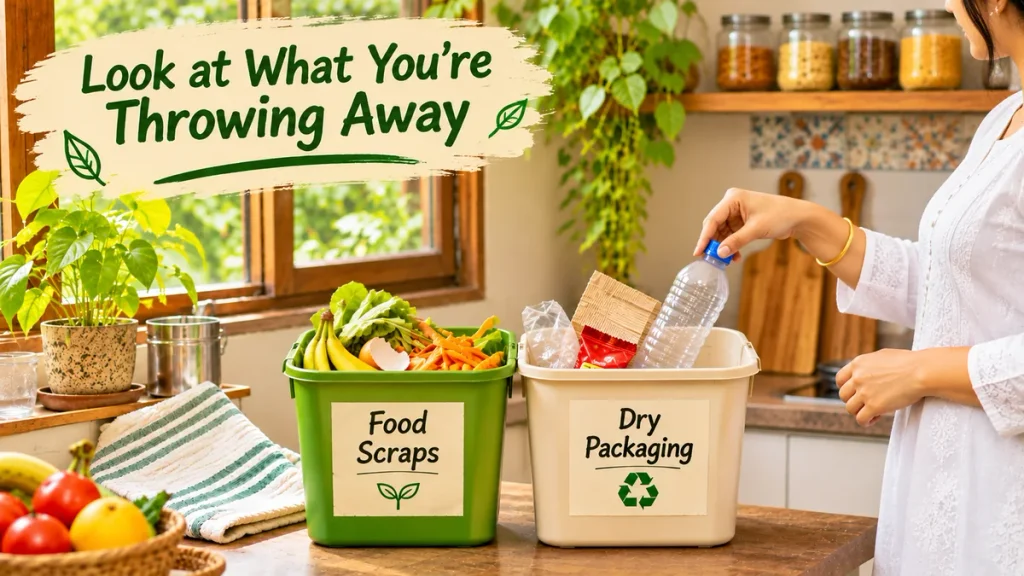
Step 1: Look at What You’re Throwing Away
Before changing your shopping habits, find out what’s filling your bin.
No need to tip rubbish onto the kitchen floor. Just pay attention when you throw something away.
Are snack wrappers piling up? Do you regularly scrape leftover rice into the bin? Are takeaway containers taking up most of the space?
You may keep a rough record for seven days. Your phone’s notes app or a scrap of paper will do.
For example:
- Monday: Two biscuit wrappers and leftover rice.
- Tuesday: A takeaway container and vegetable peels.
- Wednesday: An empty shampoo bottle and three grocery packets.
By the weekend, you may spot a pattern. Perhaps you buy more snacks than you realise, or cook too much rice at dinner.
These observations give you a useful starting point for your zero waste lifestyle.
Beginner tip: Choose the waste category that appears most often. If food waste fills your bin, deal with that before worrying about shampoo bottles.

Step 2: Use What You Already Own
One of the simplest ways to start a zero waste lifestyle is to make better use of the things you already own.
Before spending money on reusable products, have a proper look around your house.
Those plastic storage boxes in your kitchen? Keep using them if they’re still suitable and safe for their intended purpose.
Replacing them with brand-new glass containers won’t undo the resources that went into making the plastic ones.
You can also give ordinary household items another job.
Wash an empty pickle jar and use it for dry lentils. Cut a worn cotton T-shirt into dusting cloths. Keep sturdy cardboard boxes for organising cupboards.
Small repairs help, too. A loose handle or torn seam doesn’t always mean an item has reached the end of its life.
Beginner tip: Before buying a replacement, check your cupboards. You might already have something that works.
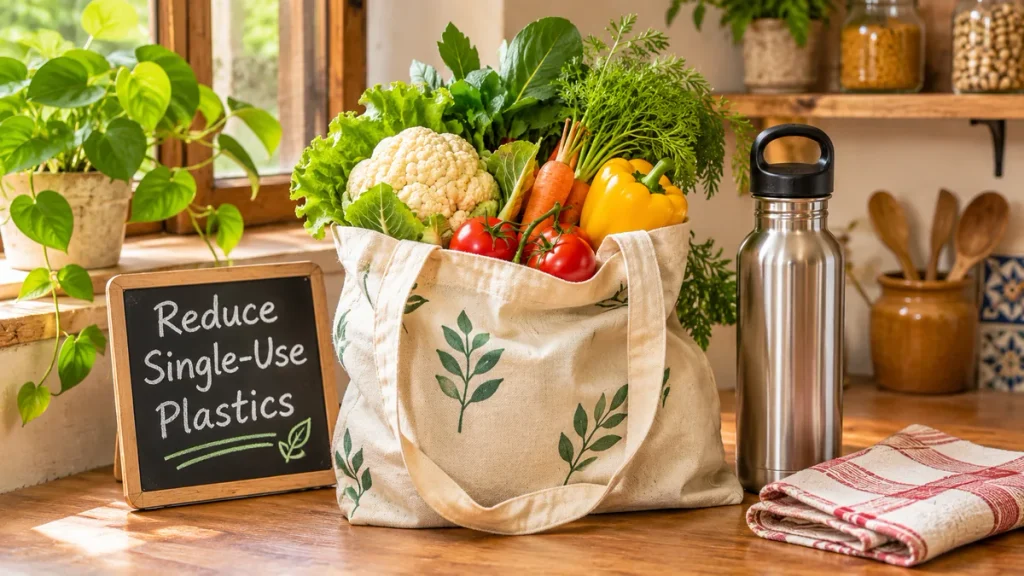
Step 3: Reduce Single-Use Plastics Gradually
Plastic turns up everywhere, from biscuit packets to takeaway containers.
Trying to avoid every piece of it can make a simple grocery trip exhausting.
A zero waste lifestyle doesn’t require you to eliminate every plastic item overnight. Start with the disposable products you use regularly.
If you buy tea or coffee in a disposable cup every morning, ask whether the stall will fill a cup you bring from home.
Carry a refillable bottle when you have access to safe drinking water. Keep a folded shopping bag in your backpack, not in a cupboard where you’ll forget it.
Ordering takeaway? Skip the disposable cutlery if you’re eating at home.
These small zero waste lifestyle habits won’t eliminate plastic from your life, but they can cut down on items you use for a few minutes before throwing them away.
You’ll still forget your bag occasionally. It happens.
Beginner tip: Focus on the disposable items you use most often. Don’t throw away functional plastic products just to replace them with something labelled reusable.

Step 4: Reduce Food Waste in Your Kitchen
I think you may be aware that food waste can quietly eat into your grocery budget.
A left-behind tomato turns soft at the back of the fridge. Half a cauliflower stays untouched until brown patches appear. Yesterday’s dal gets pushed behind a fresh container.
Reducing food waste is one of the most practical zero waste lifestyle habits because it can save money without requiring expensive products.
Start checking your fridge before you go shopping.
Suppose you find two tomatoes, one carrot, half a cauliflower, some cooked dal, and a little uncooked rice. You also have potatoes, atta, and spices in the cupboard.
You could plan three meals around those ingredients.
Day 1: Cauliflower and Potato Curry with Roti
Use part of the cauliflower, one tomato, and a potato. Serve the curry with fresh roti and the cooked dal, provided you’ve stored it safely.
Day 2: Vegetable Khichdi
You should think of something meaningful that uses the remaining cauliflower, carrot, tomato, and rice. Add fresh dal from your pantry if needed. Cook enough for the meal rather than making a huge pot that nobody finishes.
Day 3: Potato Curry with Roti
With the more perishable vegetables gone, make a simple potato curry using your remaining pantry ingredients.
You haven’t cooked anything unusual. You’ve simply planned meals around the food that needed attention.
For food safety, refrigerate cooked dal promptly and use it within 3–4 days or freeze it. Cool cooked rice quickly, refrigerate it promptly, and use it within 24 hours. Reheat leftovers thoroughly.
Vegetables that have softened somewhat may still work in soups or curries, provided they show no signs of spoilage.
Beginner tip: Keep an “eat first” section in your fridge. Put the food that needs using soon where you can see it.
Step 5: Think Twice Before You Buy
A zero waste lifestyle isn’t only about what goes into your rubbish bin. It also requires paying attention to what you bring home.
Sometimes the easiest way to reduce waste is to leave something on the shop shelf.
That doesn’t mean you should stop buying things you enjoy. It means taking a moment before bringing home another item you might barely use.
A shirt with a loose seam might only need stitching. A drill for one small job might be something you can borrow. Used books can be a good option when you don’t need a new copy.
The same thinking applies to groceries.
Loose vegetables may help you avoid packaging when they’re available at a reasonable price. Buying rice or lentils in bulk can also reduce packaging, but only if you can store and use the food properly.
A 10 kg bag isn’t a bargain if half the contents spoil.
Beginner tip: Give non-essential purchases 24 hours before deciding. You may find you don’t need them after all.
Step 6: Make Your Bathroom Less Wasteful
Bathroom shelves collect plastic surprisingly quickly.
There’s the shampoo bottle, the toothpaste tube, the empty body-wash container, and the disposable razor you keep meaning to replace.
You don’t need to clear the shelf and start again.
Finish the products you already have.
When your body wash runs out, you could try an ordinary bar of soap. If a nearby shop sells affordable shampoo refills, check whether you can reuse your bottle.
An old cotton towel can also become several washable cloths for bathroom cleaning.
These small adjustments can help you cut down on bathroom waste without spending much money. You don’t need to replace everything at once.
Some swaps might not work for you, and that’s fine. If you need certain products for your health or personal hygiene, keep using them. There’s no point giving up something you need just to avoid a bit of packaging while building your zero waste lifestyle.
Beginner tip: When a bathroom product runs out, try a different option if it makes sense for your budget. If it works well for you, stick with it.
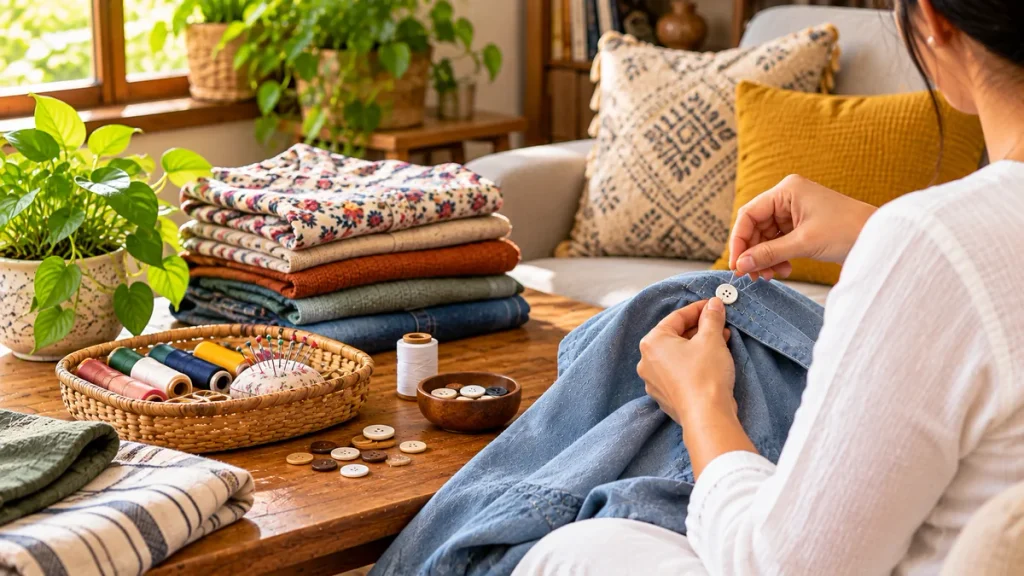
Step 7: Repair, Reuse, and Buy Second-Hand
A missing button is a poor reason to throw away a good shirt.
The same goes for a bag with a damaged zip or a chair that wobbles because a screw has come loose.
Repairing and reusing everyday belongings can help you maintain a zero waste lifestyle without constantly buying replacements.
You can handle plenty of small repairs at home.
- Clothes: Sew on buttons, stitch small tears, or patch worn knees.
- Bags: Replace a broken zip pull or ask a tailor to repair a damaged zip.
- Furniture: Tighten loose screws or repair suitable wooden joints.
- Shoes: Replace worn laces or take damaged footwear to a cobbler.
- Household items: Fix a loose cupboard hinge or mend a torn pillowcase.
You don’t need to become a repair expert.
A local tailor or cobbler can often save an item for much less than the cost of replacing it.
Use some caution, though. Leave damaged electrical wiring and internal appliance repairs to qualified professionals. Don’t trust quick fixes on cracked ladders, badly damaged chairs, or helmets that have taken a hard impact.
Buying second-hand also supports a zero waste lifestyle by extending the useful life of existing products.
Check used furniture, clothes, and books carefully before bringing them home. Look for damage, mould, and pests.
And don’t buy something just because it’s cheap.
Beginner tip: Keep a small repair box with needles, thread, spare buttons, and basic tools. Store sharp objects and small parts safely away from children.
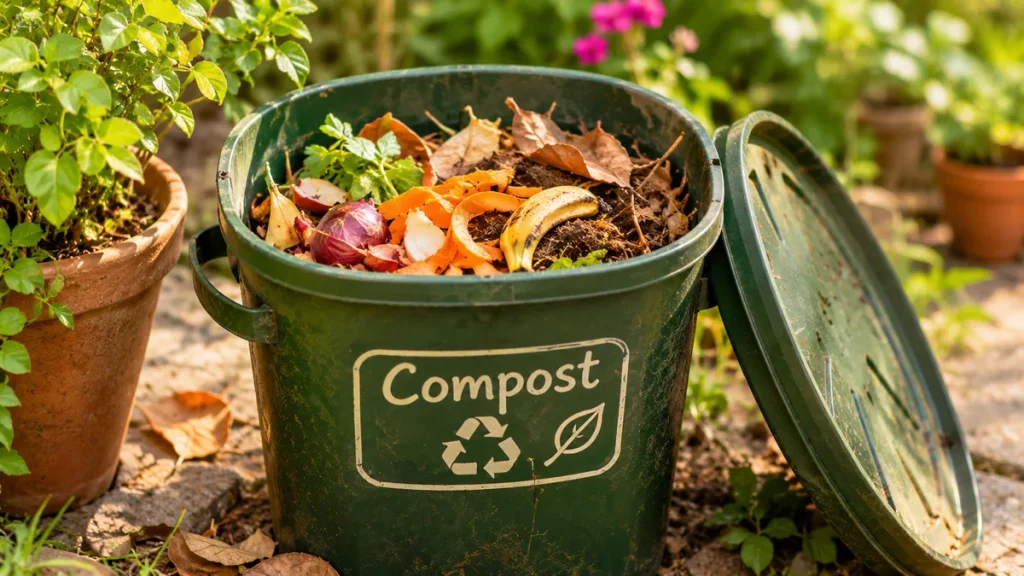
Step 8: Compost Food Scraps If You Can
If vegetable peels and fruit scraps fill a large part of your bin, composting might be worth trying.
Composting can help reduce kitchen waste as part of a zero waste lifestyle, especially if you have somewhere to use the finished compost.
A properly managed compost system can turn suitable kitchen scraps and dry garden waste into material you can use in soil.
If you have a backyard, you could start with a compost bin and mix vegetable scraps with dry leaves or shredded cardboard.
Apartment living makes things trickier.
You may need a compact composting system, enough space to manage it properly, or access to a community collection service.
Composting also takes some attention. Too much moisture can create unpleasant smells, while unsuitable food scraps may attract pests.
If you can’t manage a compost bin right now, don’t force it.
Using food before it spoils is still worth doing.
Beginner tip: Check what your composting method accepts. Cooked food, dairy, and oily leftovers don’t suit every system.
Step 9: Learn How Recycling Works Where You Live
Recycling plays a role in a zero waste lifestyle, but a recycling symbol on a packet doesn’t guarantee that someone will recycle it.
Your local waste collector might accept plastic bottles and cardboard but refuse multilayer snack wrappers.
Food residue can cause problems, too.
Check what your municipality or local collection service actually accepts.
Separating household waste is a useful habit when you’re starting a zero waste lifestyle. Keep food scraps away from dry waste, and check which materials your local collection service accepts. The Government of India’s Swachh Bharat Mission (FAQ Section) also provides information about waste segregation, composting, and household waste management. It’s a helpful place to learn more, although you’ll still need to follow your local waste collection rules.
If your area supports separate waste collection, keep wet food waste away from clean, dry recyclables.
You might use one container for vegetable peels and leftover food, and another for accepted paper, cardboard, and empty bottles.
Keep used batteries and broken electronics separate until you can take them to an authorised collection centre or take-back programme.
Don’t put damaged batteries or electrical items in ordinary household rubbish.
Beginner tip: Ask your local waste collector which materials they accept. Their answer is more useful than guessing from the symbols on packaging.
Step 10: Build Habits You Can Actually Maintain (The Final Step)
You’ve now covered the practical side of cutting waste, from shopping and food storage to repairs and recycling.
This final step is about making your zero waste lifestyle work over the long term.
It’s easy to remember your reusable bag when you’re planning a shopping trip. Less so when someone asks you to pick up groceries on your way home from work.
Make the habit easier.
Leave a folded bag near your keys. Put leftovers at the front of the fridge. Check your cupboard before adding another storage container to your shopping list.
You’ll still buy packaged groceries sometimes. You might forget your bottle or discover that the local recycling service doesn’t accept half the things you hoped it would.
Work around those problems where you can.
Beginner tip: Your zero waste lifestyle should fit your daily routine and budget. Stick with what works for you, and try something new when you feel ready.
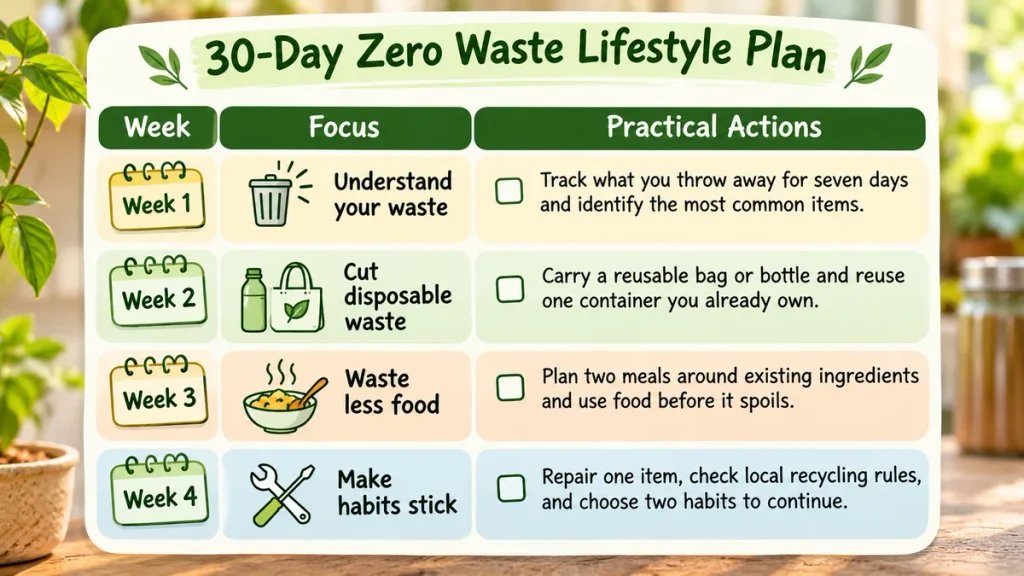
A Simple 30-Day Zero Waste Lifestyle Plan
You don’t need to follow all 10 steps at once to start a zero waste lifestyle. Spreading them over a month makes them easier to try.
You don’t need special equipment or a complicated tracking system.
| Week | Focus | Practical Actions |
| Week 1 | Understand your waste | Track what you throw away for seven days and identify the most common items. |
| Week 2 | Cut disposable waste | Carry a reusable bag or bottle and reuse one container you already own. |
| Week 3 | Waste less food | Plan two meals around existing ingredients and use food before it spoils. |
| Week 4 | Make habits stick | Repair one item, check local recycling rules, and choose two habits to continue. |
Your Weekly Zero Waste Check-In
At the end of each week, take five minutes to see how you’re doing. Check your notes to find out what’s working and what needs to change.
Week 1: Understand Your Waste
Look back at what you threw away during the week. Was it mostly plastic wrappers, food scraps, or takeaway containers? Did you waste more food than you expected?
Pick one disposable item you often throw away and try to reduce it next week.
Week 2: Reduce Disposables
Count how often you remembered your reusable bag or bottle.
A note such as “Used my shopping bag four times, forgot twice” gives you something concrete to work with.
Week 3: Waste Less Food
Did you manage to cook two meals using ingredients you already had?
Check whether anything spoiled before you could use it. If so, think about whether you bought too much or stored it poorly.
Week 4: Build Lasting Habits
Look at the item you repaired and the recycling information you found.
Which two changes caused the least hassle? Those are good candidates to continue next month
Your bin might still fill up faster than you’d like after 30 days.
The point of this zero waste lifestyle plan isn’t to produce no rubbish in a month. It’s to discover which habits help you waste less without making your days harder.
Common Zero Waste Lifestyle Mistakes to Avoid
Starting a zero waste lifestyle takes some trial and error. A few common mistakes can make the process more expensive or frustrating than it needs
1. Buying Too Many Reusable Products
You see a set of glass containers online, and immediately your perfectly usable plastic boxes look inadequate.
Keep them.
An old pickle jar can hold lentils, and the cloth shopping bag you already own works just as well as a new one with a sustainability slogan printed on it.
2. Trying to Avoid Every Piece of Plastic
Your local grocery shop might sell biscuits, rice, or cooking oil in plastic packaging.
You can’t always choose another option, especially when unpackaged alternatives cost more or aren’t available.
Focus on unnecessary bags, disposable cups, and other items you can realistically avoid.
3. Assuming Expensive Products Are Better
A higher price doesn’t guarantee a lower environmental impact.
Stitching a torn shopping bag or cutting up an old towel often makes more sense than buying a replacement.
Check whether a product solves a real problem before spending money on it.
4. Relying Only on Recycling
Recycling has its place, but it doesn’t solve the problem of buying more than you need.
An unused coffee jar might have years of use left as a storage container. Leftover vegetables could become tomorrow’s lunch instead of going into the bin.
Preventing waste is often simpler than dealing with it afterwards.
A zero waste lifestyle doesn’t require perfect products or a plastic-free home. The most useful changes are usually the ones you can keep doing without much effort.
Final Thoughts: Start Small and Keep Going
Your zero waste lifestyle doesn’t have to look like the picture-perfect kitchens you see on social media.
Forget the matching glass jars and neatly arranged pantry shelves. What matters is finding ways to waste less that fit your daily routine, the groceries available at your local shops, and what you can realistically afford.
Some changes will stick quickly. Others will take more effort. Eventually, carrying a shopping bag or checking the fridge before buying vegetables may become something you do without thinking about it.
You won’t control every plastic wrapper that enters your home, and you won’t always have a convenient recycling option.
That’s part of the reality of decreasing waste.
Here’s your next step: Look inside your rubbish bin today. Find one item you throw away regularly and choose a way to reduce it over the next seven days.
Maybe it’s leftover food. Maybe it’s plastic shopping bags.
Pick something you can manage with what you already have, and give it a week.